Custom Sunscreen Manufacturing: From Brief to Broad-Spectrum Claim
A sunscreen development project moves through a fixed sequence: a written brief, a formula, a test result, and only then a claim. The client site publishes capacity of 160M units a year and 200,000 a day across 35 automated production lines, which works out at about 5,714 units per line per day. For the US market it also notes that sunscreen is classified as an OTC drug and regulated by the FDA, so a broad-spectrum test sits on the critical path. This article follows one brief from start to claim.

Key takeaways
- Published capacity runs at 200,000 units a day across 35 lines, about 5,714 units per line per day.
- The US treats sunscreen as an OTC drug, so registration and product listing apply.
- The broad-spectrum test is described with a critical wavelength requirement of at least 370 nm.
- A ready formula keeps the project near four to eight weeks, and a developed one nearer three to six months.
What a brief-to-claim pipeline actually covers
A brief is not a wish list. It is the document that fixes what the product is for, who applies it, what it should feel like, and which market it will be sold in. Everything downstream, from formula selection to packaging and testing, is an answer to something the brief should already have asked.
From there the pipeline narrows. Formula selection comes first, then the broad-spectrum work that supports the claim, then stability and compatibility checks, then production. Skipping a stage does not remove the work; it moves the problem to the end of the run, where it is more expensive to fix. That is why the sequence matters more than the speed of any single step.
Why the US market frames sunscreen as an OTC drug
In the US, sunscreen products are classified as OTC drugs and regulated by the FDA, and the client site applies that framing when it describes the market. That changes the paperwork before it changes the formula. Enterprise registration and product listing apply, so a brand has to be recorded as a facility and the product has to appear on a listing.
For a private label brand this is the point where a cosmetic mindset stops being enough. A sunscreen sold into the US is not just a moisturiser with a UV filter in it; it carries a drug claim, and the claim has an evidentiary trail behind it. The brief should name the market early so the pipeline can be built around the right evidence.
The broad-spectrum test and the 370 nm line
The broad-spectrum test is described on the client site with a critical wavelength requirement of at least 370 nm. In plain terms, the formula has to protect across the UVA part of the spectrum, not only the UVB band that drives the SPF number. A formula that clears the SPF target but falls short on wavelength does not get the broad-spectrum claim.
That single number is worth carrying into the brief. It tells the formulator that the UVA filters are not optional decoration and that the test result, not the intention, is what unlocks the label wording. It also explains why stability and compatibility reports take 3–6 months: the evidence has to be gathered before the claim is printed, not alongside it.
What the published capacity says about scheduling
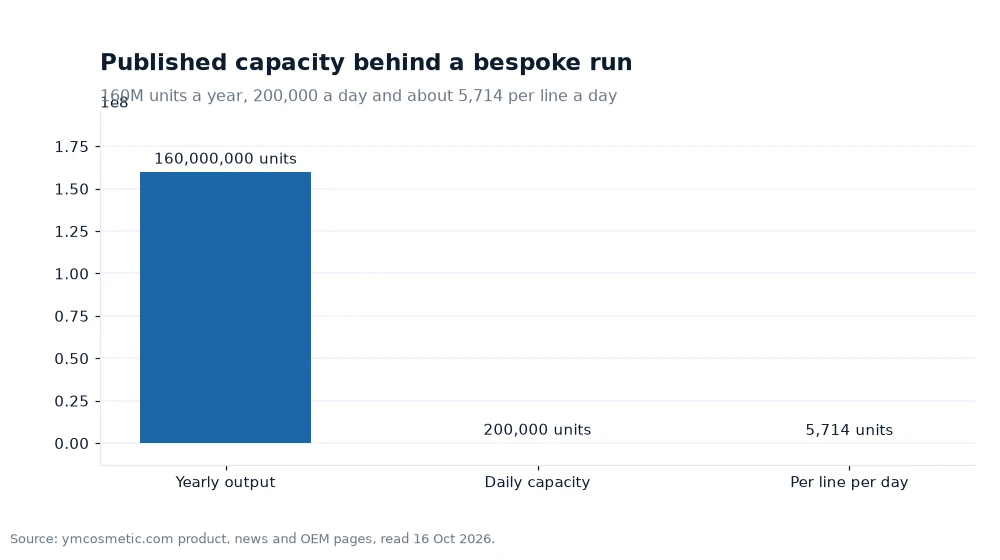
The client site publishes 160M units a year and 200,000 units a day, running across 35 automated production lines. Divided evenly, that daily figure is about 200,000 ÷ 35 ≈ 5,714 units per line per day. Those three numbers are the ones a brand should use when it asks how long a run will take.
Capacity is not the same as a quote. A run has to fit the schedule, the component has to arrive, and the stability window has to close before the product ships. The published figures tell a brand what the plant can do in a day; they do not tell a brand when its own slot opens. Asking for both, early, keeps a launch on its feet. The formats a run can be built around are listed on the sunscreen cream and spray range page.
| Measure | Published figure | How a brand reads it |
|---|---|---|
| Yearly output | 160M units | Headline scale of the plant |
| Daily capacity | 200,000 units | Planning figure for a working day |
| Per line per day | About 5,714 units | 200,000 ÷ 35; sets the pace of one line |
Worked example: sizing a 30,000-unit run
Suppose a brand wants a 30,000-unit first run and asks how much line time it needs. Using the published per-line figure of 5,714 units a day, one line would take 30,000 ÷ 5,714 ≈ 5.25 days. That is a workable but unhurried schedule. If the run is spread across five lines, the arithmetic becomes 30,000 ÷ (5 × 5,714) = 30,000 ÷ 28,570 ≈ 1.05 days.
Now scale the same method to a bigger order. A 200,000-unit run is one full day at the published daily capacity, or 200,000 ÷ 5,714 ≈ 35 line-days if it were pushed through a single line. The point is not that a brand should split a job across every line; it is that the published capacity figures let a brand convert a unit count into days before the conversation starts. That keeps the timeline grounded in numbers instead of hope.
Reading the chart
The chart uses three different scales, so it is best read as a set of references rather than as a height comparison. The yearly output of 160,000,000 units is the long-range number. The daily capacity of 200,000 units is the operational number. The per-line figure of about 5,714 is the one that converts a unit count into days.
The two numbers to hold onto are 200,000 and 5,714. The first tells a brand how much the plant moves in a day; the second, obtained as 200,000 ÷ 35, tells a brand how much a single line moves. Everything in a run estimate follows from those two figures, and they are the ones to quote back when a schedule is being discussed.
Choosing between ODM speed and OEM development
The two routes answer different questions. ODM uses an existing formula and runs 4–8 weeks, which suits a brand that wants a tested foundation and a fast route to shelf. OEM runs 3–6 months including research, testing and production, and suits a brand that needs a formula built around its own brief.
The client site lists more than 10,000 mature formulas and offers fine-tuning of fragrance, texture and skin feel, so the ODM route is not a single template. A brand can start from a nearby formula and adjust it, or commit to the longer OEM path when the brief cannot be met from the library. Yunmei provides a custom sunscreen route as part of its OEM/ODM service, and the sunscreen range shows the cream and spray formats that a brief can build on.
Frequently asked questions
What does the broad-spectrum test require on the client site?
The site describes the broad-spectrum test with a critical wavelength requirement of at least 370 nm, which is the evidence a brand needs before printing a broad-spectrum claim.
How are US sunscreens regulated according to the client site?
In the US, sunscreen products are classified as OTC drugs and regulated by the FDA, so enterprise registration and product listing apply to a sunscreen sold into that market.
How long do ODM and OEM sunscreen projects take?
ODM runs 4–8 weeks on an existing formula, while OEM runs 3–6 months including research, testing and production. Stability and compatibility reports take 3–6 months.
Starting the brief with the end claim in mind
The cleanest projects work backwards. A brand decides which claim it wants to print, checks what evidence that claim needs, and only then writes the formula brief. That order keeps the broad-spectrum test, the stability window and the packaging all pointed at the same target. A brand that wants to compare timing across markets can review the sunscreen choices for global markets before the brief is signed.
The published numbers behind this article were reviewed on the company's website on 16 Oct 2026.[1]