Custom or Library Scent for a Haircare Line? An A/B Decision Framework
For a haircare brand, 'custom' and 'library' are two different products with two different budgets, not two labels on the same work. A library scent is a developed fragrance you adapt — fast, comparatively cheap, and shared with other clients unless you buy exclusivity. A custom scent is built to your brief — slower, more expensive, and exclusive. Choose with the same A/B discipline you apply to your product pages: define the criteria first, run a blind comparison, and cost the switch before you commit.
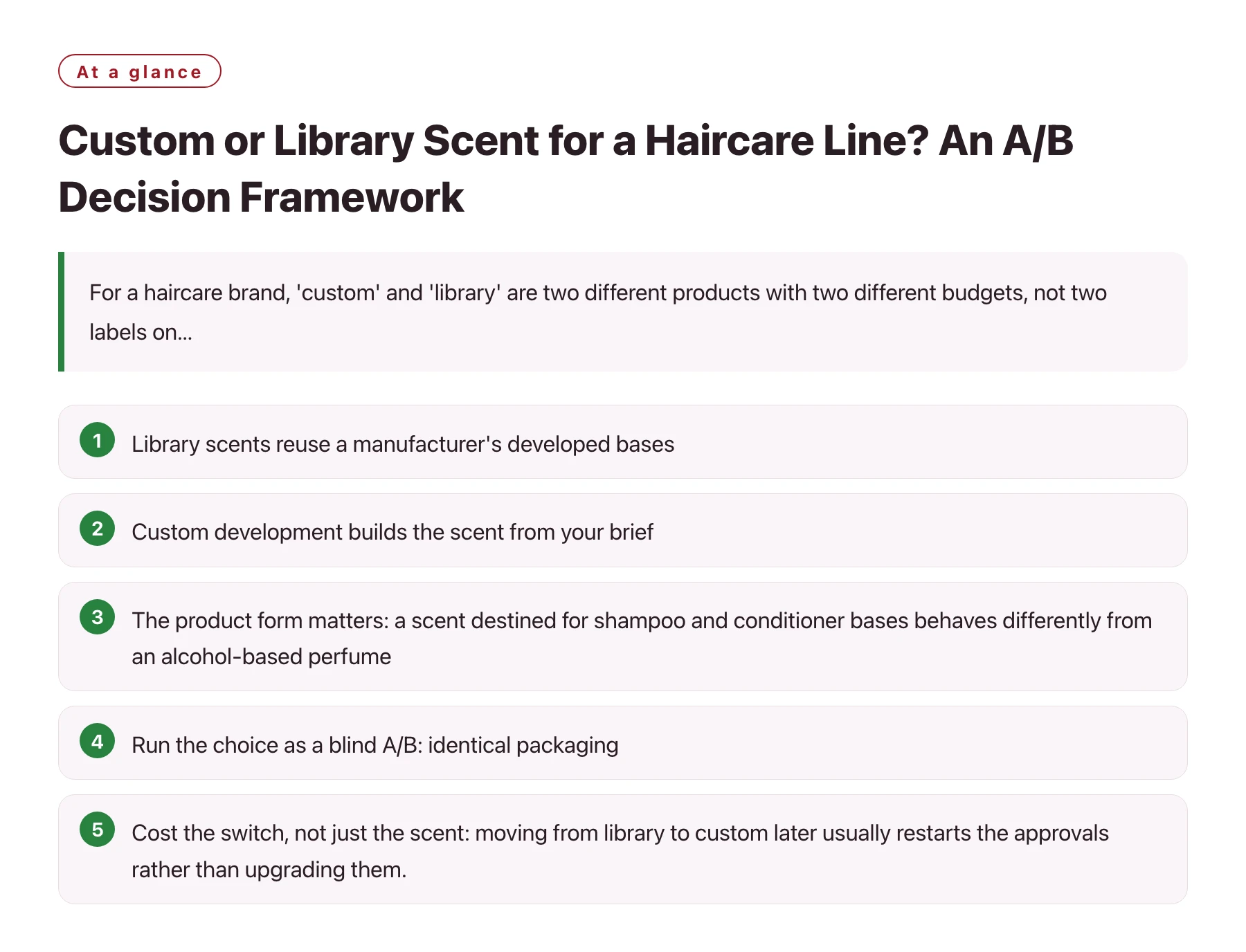
Key takeaways
- Library scents reuse a manufacturer's developed bases, so the time and cost to a first sample are lower, but the starting point is shared unless exclusivity is purchased.
- Custom development builds the scent from your brief, which means more rounds and a higher upfront fee but a starting point no other client holds.
- The product form matters: a scent destined for shampoo and conditioner bases behaves differently from an alcohol-based perfume, and the brief must say which one it is.
- Run the choice as a blind A/B: identical packaging, coded samples, timed evaluation, and criteria agreed before the panel sniffs.
- Cost the switch, not just the scent: moving from library to custom later usually restarts the approvals rather than upgrading them.
A haircare brand rarely needs 'a perfume' in the abstract; it needs a scent identity that travels through the line — the shampoo, the conditioner, the styling product — and, often, a matching fine fragrance for the collection. That brief can be answered from two directions, and the directions lead to very different budgets.
Option A is a library scent: the manufacturer hands you a developed fragrance close to your direction, and the work is matching, packaging and approval. Option B is a custom scent: a perfumer builds from your brief, and the work is development, iterations and exclusivity.
This article turns the choice into an A/B comparison — what each option is, the criteria that separate them, and how to test the decision without fooling yourself.
What option A and option B actually are
Option A — adapt a library scent
The manufacturer holds a range of developed accords accumulated across past projects. Matching your direction means adjusting an existing base rather than composing from nothing, which shortens the first sample and the price. The trade-off is that the starting point may be offered to other clients too; exclusivity, where it matters, is a separate purchased clause.
Option B — build a custom scent
A perfumer works from a written brief — scent direction, product form, target market, usage — and builds the composition in rounds. The upfront development fee is higher and the calendar longer, but the result starts as yours, which is what most brands mean when they say the scent is the product.
Where the line blurs
Between the two sits a broad middle: brands buy exclusivity on a library scent, or let the manufacturer develop the concept from a loose brief — the ODM route, where the factory acts as an ODM partner for fragrance brands and owns the development work. For a first haircare collection this middle is often the honest answer: custom enough to feel owned, fast enough to ship.
The decision, side by side
| Criterion | Option A: library scent | Option B: custom scent |
|---|---|---|
| Time to first sample | Faster — existing bases are adapted | Slower — composition is built from a brief |
| Upfront cost | Lower — matching work only | Higher — development billed separately |
| Exclusivity | Only if purchased as a clause | Included in the development |
| Fit to a specific brief | Approximate — the nearest base wins | Precise — the brief is the starting point |
| Scent as a brand asset | Limited — others may share the base | Strong — the composition starts as yours |
| Revision cost | Cheaper — bases already exist | More rounds, more fee |
| Best for | Testing a market or a price point | Building a signature the line is named for |
Read the last row first. The two options answer different questions: A asks 'can we sell this scent?', B asks 'do we want to be this scent?' A brand that has not answered the second question pays for B and gets A.
When each option wins
A wins when you need to test a market fast
If the goal is to learn whether a haircare line carries a fragrance at all — price point, sell-through, repeat purchase — a library scent gets you to a testable product at the lowest risk. Brands that skip this step often discover the category, not the scent, was the variable.
B wins when the scent is the product
When the fragrance runs through the whole line, appears on the bottle and in the marketing, and is the reason a buyer chooses it over a competitor, the exclusivity of a custom development is the point. Here the development fee is not a cost line; it is the price of the asset.
The hybrid: validate with A, commit with B
A common route is a library scent for the first season and a custom development for the second, with the ownership and exclusivity terms written at the start so the transfer is a handover, not a rebuild. Whichever route is chosen, the scent still needs stability and quality-control testing before scale-up; GMP-style frameworks and third-party laboratories such as SGS exist to run those verifications [3].
Running the comparison without fooling yourself
Blind codes and identical presentation
Put both candidates in identical bottles with codes, apply the same amount on the same blotter, and let the panel score without knowing which is A and which is B. If the panel knows the library scent is cheaper, the comparison is already decided.
Timed evaluation with agreed criteria
Agree the criteria before sniffing — opening, heart, dry-down, intensity, fit to the brand — and score each at fixed points rather than as one impression. The haircare brief adds its own questions: how the scent sits on freshly washed hair and how it survives the rinse-off moment are part of the test, not extras.
Safe-use and market checks before you commit
Both routes must respect the safe-use limits for the intended product category, because the same concentrate at a different use level is a different safety question [1], and the finished product must satisfy the rules of the markets it sells into — in Canada, for example, cosmetics must be notified and meet safety requirements before sale [2]. Neither check is expensive; both are expensive to skip.
The decision in practice
The brief is where the choice is actually made. A haircare brand that commissions the scent from a custom perfume manufacturer in China will find that the written brief decides most of the cost and the calendar — product form, use level, target markets, the acceptable number of rounds, and whether exclusivity is required.
When the decision becomes a page — criteria, the codes of the two candidates, the panel scores, the safe-use and market checks, and the approval reference — it survives a board meeting, a supplier change and a second season. Six months later that page is the document that lets you defend the choice, and the one the next collection reuses.
Sources
- IFRA: Safe Use and Fragrance Science —— IFRA's explanation of how fragrance materials are scientifically assessed for safe use and how those conclusions are applied by the industry.
- Health Canada: Cosmetic Safety —— Health Canada's cosmetics pages, covering cosmetic notification, the ingredient hotlist and safety requirements for cosmetics sold in Canada.
- SGS: Cosmetics, Personal Care & Household Testing —— Testing, inspection and certification services for cosmetics and personal care, including microbiological, stability and safety testing aligned with cosmetics GMP.
Frequently asked questions
How much faster is a library scent than a custom one?
Faster to a first sample, because existing bases are adapted instead of composed. There is no universal week count — ask both timelines in writing, and add the resting and stability periods on top.
Can I make a library scent exclusive?
Often yes, by purchasing an exclusivity clause, which changes the price and must be written in the contract. Without the clause, assume the base may be offered to other clients.
Does a haircare product need a different scent than a perfume?
The product form changes the formulation and the stability work; a concentrate built for an alcohol-based perfume may not behave in a shampoo or conditioner base without rework. Say which form the brief targets.
What should the brief contain?
Product form, use level, target markets, scent direction, the number of sample rounds, and whether exclusivity is required. The more precise the brief, the more comparable the quotes and the fewer the surprise rounds.
Can I switch from library to custom later?
Yes, but treat it as a new development: new brief, new rounds, new approvals. Write the ownership and exclusivity terms at the start so the later switch is a handover rather than a rebuild.