A 0.001 BTC Daily Check for a Newly Installed Miner
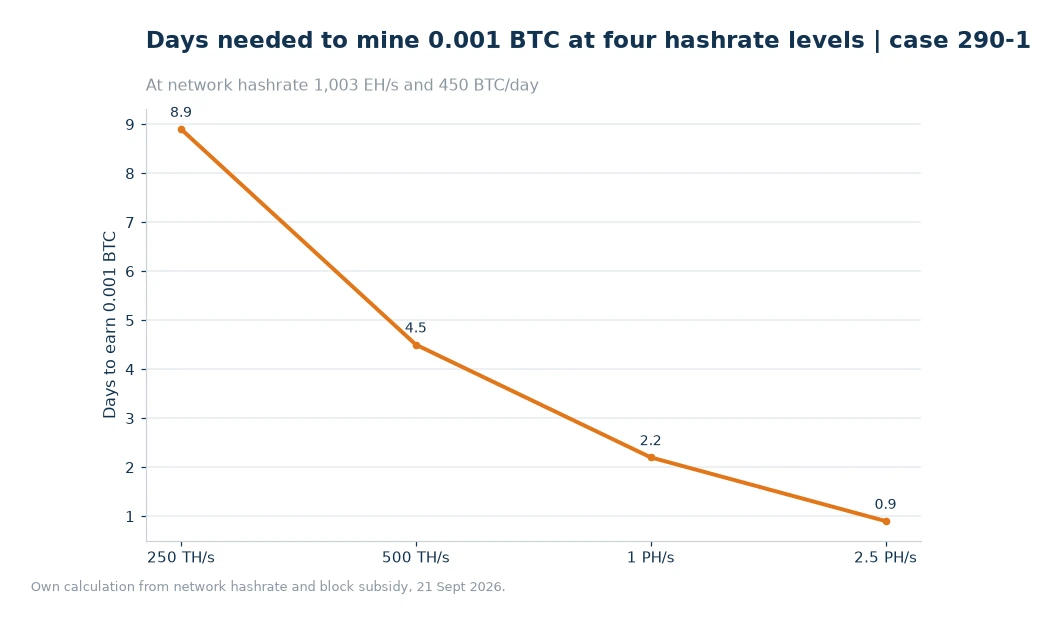
The day after a machine goes in, the only question that matters is whether it is doing the work you paid for. One thousandth of a bitcoin gives that question a deadline: at 250 TH/s it arrives in 8.9 days, at 1 PH/s in 2.2 days, and at 2.5 PH/s in under a day. If the balance is nowhere near the line, the fault is in the setup rather than the market.

Key takeaways
- 0.001 BTC is worth about $84.69 at $84,692, a small enough target to test a new install quickly.
- A 250 TH/s machine reaches it in 8.9 days; a 2.5 PH/s machine needs 0.9 days.
- The first check should compare credited hours with expected hours, not just the closing balance.
- A worker that appears in the dashboard but earns nothing is usually pointed at the wrong coin or the wrong account.
The first number to check after power-on
Installations fail in boring ways. A pool URL with a typo, a worker name that never reaches the server, a wallet address for the wrong coin, a firewall that allows the dashboard but not the stratum port. None of these stop the fans from spinning, and all of them produce a machine that looks busy and earns nothing.
The credited balance is the only check that covers the whole path. Hashrate reported by the machine proves the boards work; a credit proves the shares reached the pool and were accepted. Those are different claims, and a new install deserves both before the packaging goes in the bin.
Why one thousandth of a coin makes a good test
The target is arbitrary but well sized. It is small enough that a mid-range machine reaches it within a week or two, so the test completes while the install is still fresh. It is large enough that a wrong address or a dead worker cannot hide inside rounding. And it is a round number, which makes the mental division easy when you are standing in front of a rack.
It also survives a change of hardware. Upgrade from 250 TH/s to 1 PH/s and the same line arrives in 2.2 days instead of 8.9, so the check gets faster without any change to the method. A test that scales with the machine is more useful than one that has to be recalibrated after every purchase, and it keeps comparisons between sites meaningful.
Compare it with a daily target. A single day at 250 TH/s produces 0.00011215 BTC, so a one-day check would test about a ninth of the line and could be confused with a slow start. Stretching to 0.001 BTC removes that ambiguity: either the machine produced roughly nine days of output, or it did not. That clarity is worth the wait when a supplier is asking whether the unit works.
Expected waits by machine size
The rows below use the same network inputs and differ only in hashrate. Hours are shown for the fast machines because the wait is shorter than a day.
| Machine | BTC per day | Days to 0.001 BTC | Hours |
|---|---|---|---|
| 250 TH/s | 0.00011215 | 8.9 | 213.6 |
| 500 TH/s | 0.00022430 | 4.5 | 108.0 |
| 1 PH/s | 0.00044861 | 2.2 | 52.8 |
| 2.5 PH/s | 0.00112152 | 0.9 | 21.6 |
The last row is the awkward one for a verification plan. A 2.5 PH/s installation passes the line before the first full day is over, so a "check it tomorrow" habit is already too slow. For large machines, check at six hours and again at twelve, and treat the 0.001 line as confirmation rather than as the first look. Smaller installs can follow the daily habit without missing anything.
Worked example
Take the 250 TH/s machine and follow the output down to hours.
- Network rate per TH/s: 450 ÷ 1,003,000,000 = 0.00000044865 BTC each day.
- So at 250 TH/s the daily figure is 250 × 0.00000044865, or 0.00011215 BTC.
- Days to the line: 0.001 ÷ 0.00011215 = 8.9 days.
- In hours: 8.9 × 24 = 213.6 hours.
- Hourly credit: 0.00011215 ÷ 24 = 0.000004673 BTC.
- Value of the target: 0.001 × 84,692 = $84.69.
Pool Hashrate, Pool Luck and a normal first day
A first day never matches the calculation exactly, and the reasons are usually mundane. The machine spent an hour updating firmware, the pool had a difficulty boundary, or the operator started the worker in the afternoon. What matters is the order of magnitude, not the third decimal place. A reading within a few percent of the expected daily figure is a pass; a reading at half of it is a question worth answering before the week ends.
The ViaBTC BTC Mining Pool page gives the context for that first day. Pool Hashrate shows the collective you joined, and Pool Luck shows whether recent blocks arrived ahead of or behind expectation. Under PPS+ neither changes your credit, but both explain why the pool's own charts may look uneven while your balance climbs steadily.
When the number looks wrong
If the balance after 24 hours is far below 0.00011215 BTC at 250 TH/s, work through four checks in order. Confirm the worker appears on the pool with the expected hashrate. Confirm the payout address belongs to the coin being mined. Confirm the machine is not throttling because of temperature. Confirm the account has no hold or verification step pending.
Write the result of each check beside the time it was made. The sequence is more useful than the conclusion, because a fault that returns a week later is usually the same one, and the note tells you where to look first.
Most failures are found in the first two checks. A worker with the right name but the wrong coin will submit valid shares to a pool that credits a different currency, and the balance you are watching will stay flat. The network statistics page helps rule out the network as a cause before you start swapping cables.
Keep a short note of what changed after each fix. Installation faults often arrive in pairs, and a record of the order in which you found them saves the next person an hour. It also turns a bad afternoon into a checklist that makes the second machine faster to bring online than the first.
Frequently asked questions
How long should a new 250 TH/s miner take to earn 0.001 BTC?
About 8.9 days at current difficulty, since it produces 0.00011215 BTC a day. A machine of half that hashrate takes twice as long for the same target.
What if the machine shows hashrate but no credit?
Check the worker name, the pool URL and the coin selected for the payout address. Shares that reach a pool for the wrong coin are accepted and credited in that other currency, leaving the balance you are watching unchanged.
Is one day enough to judge a new install?
For a 2.5 PH/s machine, yes, because it passes 0.001 BTC in 0.9 days. For a 250 TH/s unit, wait the full 8.9 days before drawing a conclusion.
Record day one, then leave it alone
Write down the power-on time, the pool balance and the worker name. Check again at the hour count in the table, and compare the difference with the expected figure for your hashrate. Once the number is close, stop looking hourly. The mobile app can raise an alert if hashrate drops, which is a better use of attention than refreshing a balance that will not move until the next settlement, and it keeps a record of the drop for later. A stable install then needs almost no attention at all.
Sources: pool state, statistics and download pages on viabtc.com[1]. The snapshot used was read 21 Sept 2026: 1,003 EH/s network, 132.76 T difficulty, 3.125 BTC subsidy, BTC $84,692. Day and hour counts assume stable difficulty and no downtime; published 24 Oct 2026.